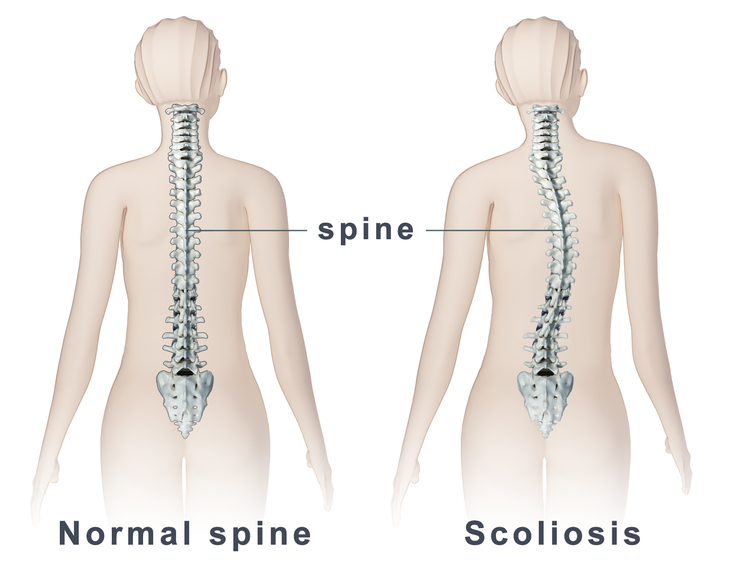
 |
| Image via Ola Natural Healing |
Depending on the degree of the curvature of the spine, scoliosis is usually treatable. There are two treatments that are commonly know: wearing a brace or having a spinal fusion surgery. If the degree of the curve is small, than most orthopedic doctors suggest doing some scoliosis-specific activities such as physical therapy. If the degree of the curve is somewhat large, but not small enough to fix with some physical therapy activities, then a spinal surgery is suggested. The spinal fusion surgery is a surgery in which orthopedic surgeon fuse some of the bones of the spine to keep it from curving even more. If the degree of the curve is substantially high, then most orthopedic doctors suggest wearing a plastic brace, sandwiching the abdominal region of the body both from the front and the back. The brace is usually used when the curvature angle is between 25-35º. However, if the brace has lowered the degree of the curvature by a certain amount, then that patient can undergo a spinal fusion surgery. Another treatment that can be used is the rod lengthening treatment which is also done surgical. This treatment is a more temporary treatment compared to the permanent status of the spinal fusion. In most cases, the rod lengthening is done before the spinal fusion so that during the time that the rod is in, it is able to control and maintain the curvature of the spine for sometime, and then the spinal fusion occurs to guarantee a more permanent state.

No comments:
Post a Comment