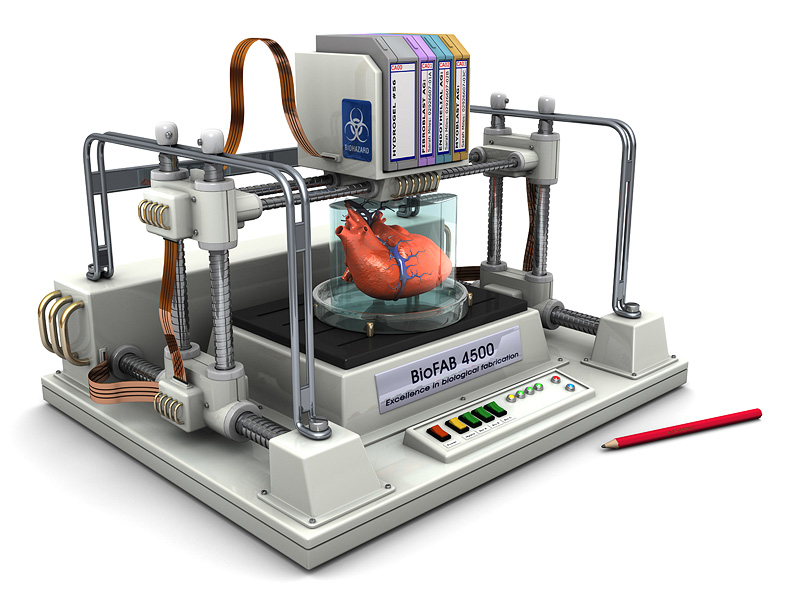
*please note that printing a heart is not yet possible. This is merely an illustration.*
Image from explainingthefuture.com
When you or someone you know is in need of an organ transplant, you go on a donor list and you wait for an organ that best matches yours. When you are presented with a match, there will aways be a risk involved with the transplant. Rejection of the organ can happen. What if there was a way that you could make the organ you desire from your own cells? All the problems with rejection would go away. This could become part of reality in the years to come. 3D bio-printing is much like normal 3D printing. The only difference is that bio-printing prints with living cells to make tissues and other structures. The process starts when some sample cells are taken from the specific organ. The cells are then rapidly multiplied. The now amplified amount of cells are then mixed into a gel, placed in a bioink cartridge, and then put into a printer. A computer with a 3D model of the desired organ sends info to the printer and the construction begins. The 3D Bio-printer begins construction layer by layer. At the end, you are left with an organ. Although we are not ready to print hearts and livers, we are currently capable of creating simpler things such as skin, cartilage, and simple hollow organs like the bladder. Solid organs like the heart and liver have not been made yet. These organs are simply too complex to print currently. When a block of tissue gets over an inch thick, cells on the inside start to die as there is no access to nutrients. Sadly, making microvascular networks for the organs is beyond our current technology. So far we can only make large vessels and hope that the cells construct the tiny capillaries. There are already plans to make printers that print skin directly onto burn victims. The development of organ printing is feasible within our lifetime.

No comments:
Post a Comment